#TECH 3.A: Layer-1, Layer-2 Scaling Techniques and Introduction to Sharding
'The Why' for Sharding!

Hi folks,
It’s been a great week for adoption of Bitcoin as a legal currency - El Salvador officially started accepting BTC payments from 7th September. So, next time when you visit El Salvador for your summer trip, do try to withdraw some cryptos from a ‘BTC ATM’ and pay for your Big Mac in the McDonald’s with BTC! Which’s the next country going all in then?
But hell did broke loose as ‘Salvadorans’ did face technical glitches while using the government’s digital wallet ‘Chivo’ which led to the plunge of Bitcoin in the markets. Adding fuel to the fire was SEC (US market regulator) sending a notice to Coinbase for launching of a new feature called ‘Lend’, which according to CEO Brian Armstrong doesn’t classify as a ‘security’ but SEC seems to have other ideas.
And the freefall began!

Well I thought I should pretty much cover a ‘TECH’ concept in today’s issue which brings me to something called as ‘Sharding’. I am gonna break down this issue into 2 parts: (as it can get a little tech-heavy for our non-tech audience)
A. Why Sharding is required for Ethereum?
B. How Sharding is implemented in Ethereum?
I am gonna cover ‘Why Sharding’ in this particular issue.
Why Sharding?
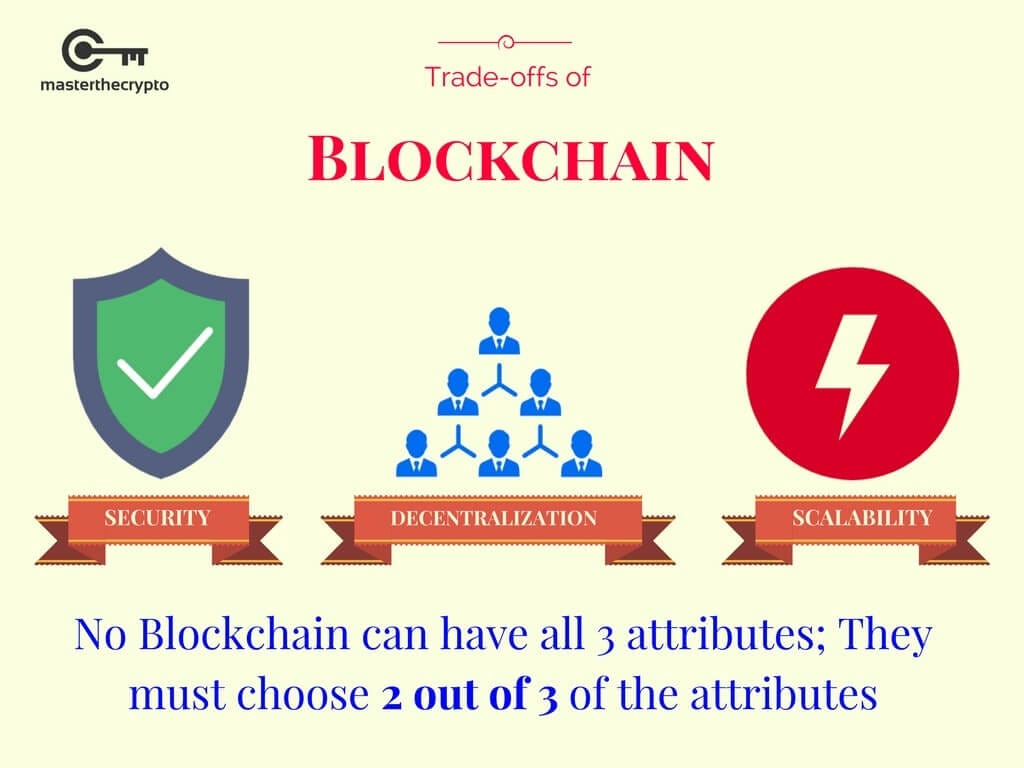
There are 3 core components of any Blockchain - Decentralization, Security and Scalability. But any blockchain project have to face a trade-off while designing its architecture as developers need to ‘sacrifice’ one aspect for the sake of the other two. This is known as the Blockchain Trilemma. Bitcoin and Ethereum blockchains focused on the ‘Decentralization’ and ‘Security’ aspects during their conceptualization, thus affecting the Scalability component.
Sharding is one of the solutions conceptualized to solve the ‘Scalability’ issue of Ethereum!
Scalability challenge
As more and more nodes get added to a Blockchain network, the data it handles increases as well. The amount of data ‘stored on each node’ also increases, thus slowing down the entire system. This is a critical issue because Blockchain has outgrown its cryptocurrency roots and is now looking at industries such as art (NFT’s), DeFi (Decentralized Finance) - which requires processing thousands of transactions real-time.
To be able to achieve its full potential, blockchains has to be able to grow exponentially without becoming too slow or bogging down the computers on which it runs. This means making it scalable and much more efficient.
Current Issue
In a Proof of Work Blockchain, each authenticating computer or node records all the data on the chain and is part of the consensus process. In large Blockchains such as Bitcoin, the majority of the participating nodes must authenticate new transactions and record that information if they are to be added to the ledger; this makes completing any transaction incredibly slow.
Because of this, Bitcoin, which runs on a Proof of Work mechanism, can only process up to ~5 transactions per second. Ethereum, its close second, is only able to process from 15–30 transactions per second. Now, let’s compare this to Visa on average it can process 1,700 transactions per second, this is not good if Blockchain wants to be successful in the future.
We do have a blockchain now: ‘Solana’ which works on a ‘Proof of History’ Consensus mechanism and can process ~50,000 transactions per second at a cost <0.01$ per transaction (gas fees). It’s being touted as a huge competitor to Ethereum but as it works on a different consensus mechanism, the concept of Sharding may not be applicable to it currently. We discuss Sharding only with respect to workings of Ethereum here.
So, how do we scale Ethereum?
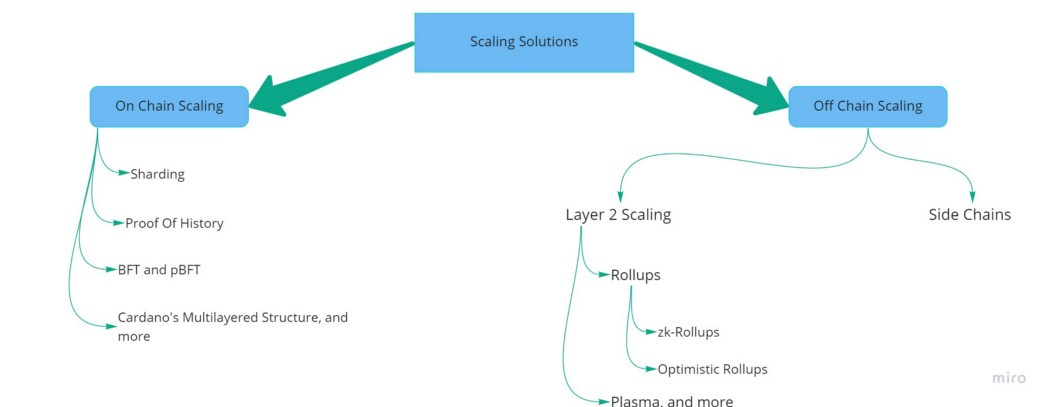
Scalability techniques mainly fall into the following categories – layer 2 and layer 1.
Layer-2 scalability
These are off-chain scalability solutions built on top of the blockchain. The idea here is to leave the base layer or Layer - 1 (Core Ethereum layer) alone and put on extra architecture on top of it.
Off-chain scaling can be divided into 2 categories - layer-2 scalability and Side chains. I am just focusing on layer-2 scaling solutions here.
Layer 2 doesn’t require any changes in Layer 1, it can be just built on top of Layer 1 using its existing elements such as smart contracts. Layer 2 also leverages the security of Layer 1 by anchoring its state into Layer 1.
Ethereum can currently process around 15 transactions per second on its base layer (Layer 1). Layer 2 scaling can dramatically increase the number of transactions. Depending on the solution, we’re talking about processing between 2000-4000 tx/second.
The 2 main capabilities that can be improved by layer-2 solutions are transaction speed and transaction throughput. On top of that, Layer 2 solutions can greatly reduce the gas fees.
Plasma and Rollups (and its different types) are examples of layer-2 scalability, which I will explore in future issues.
Layer-1 scalability
Scalability techniques that are executed within the blockchain or On-chain are called layer-1. Sharding is the most well-known layer-1 scalability techniques.
Understanding Sharding
The word “Shard” means “a small part of a whole“. Hence Sharding means dividing a larger part into smaller parts. The following image shows ‘Database Sharding’ in a normal web application:
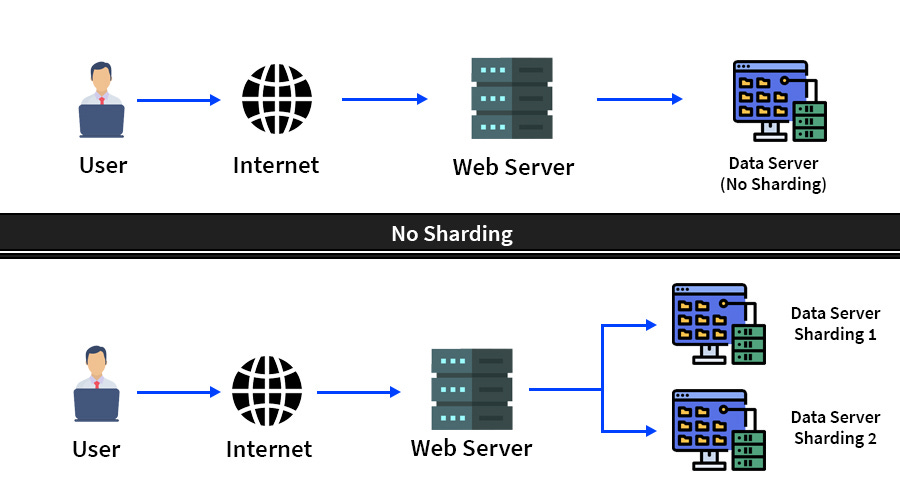
Thus, sharding looks to spread out the workload of a network into single nodes, so that a single node no longer has to process the entire network’s transactional load. Each node will, therefore, only maintain the info related to its specific partition or shards.
Sharding allows a Blockchain to remain decentralized and secure. The information in a shard can still be shared, and everyone can see all the ledger entries, but every node is freed from recording and storing all data on every other node. That allows data to be stored more quickly and makes it easier to find because its location is mapped on the Blockchain. Because fewer nodes now see and process transactions, more transactions can be processed in parallel.
I close this issue with a quote regarding Sharding from Vitalik Buterin, founder of Ethereum at the ‘Prague Devcon’ in 2018:
‘An easy way to think of it is to imagine if Ethereum was split into thousands of islands. Each island can do its own thing, it can have its own features and everyone belonging to that island can enjoy it. If they want to contact other islands, they will have to use some sort of protocol. That’s what Sharding allows. It creates a way for each shard to store individual receipts of each transaction. Since they’re cryptographically secure, they can be brought back to the main chain at any time.’
Interesting Reads and Tidbits for this week:
I have been lately following the columns and comments of the top management of my company for my Market Sizing project. Found a gem from our Chief Product Officer - Scott Belsky (founder of Behance, later acquired by Adobe) on his views on NFT’s. A top highlight from this column - “The only distinct difference about this digital transformation (Crypto-economy) from many that came before: it is empowering the careers of creators themselves more than everyone in the middle”. Read it here.
This is an old tweet but couldn’t resist sharing regarding the origin of ‘Crytpo trading cards’ by Hal Finney, wat back in 1993. Truly, a visionary!
 JUSTIN#0001@justintrimbleHal Finney calling the NFT/CryptoArt movement in 1993 . . . #NFTs #Bitcoin #BTC #ETH
 10:47 PM · Feb 3, 2021677 Reposts · 2.77K Likes

That’s for it today folks!

Sources:
https://www.coindesk.com/tech/2020/12/02/what-is-sharding/
https://education.district0x.io/general-topics/understanding-ethereum/ethereum-sharding-explained/
https://academy.ivanontech.com/blog/breaking-down-eth-2-0-sharding-explained
https://finematics.com/ethereum-layer-2-scaling-explained/
I am a sucker for validation. That’s my entire motivation. So help me get more balls and eyeballs. Balls, so that I can write more of these, eyeballs so that you can share these insights with more peeps!
Send this on WhatsApp. Share it on FB and Instagram.
Follow me (CJ) on Twitter.
You can just forward this email as well.
And if you love my content, buy me some chai to gulp and write a few more!